
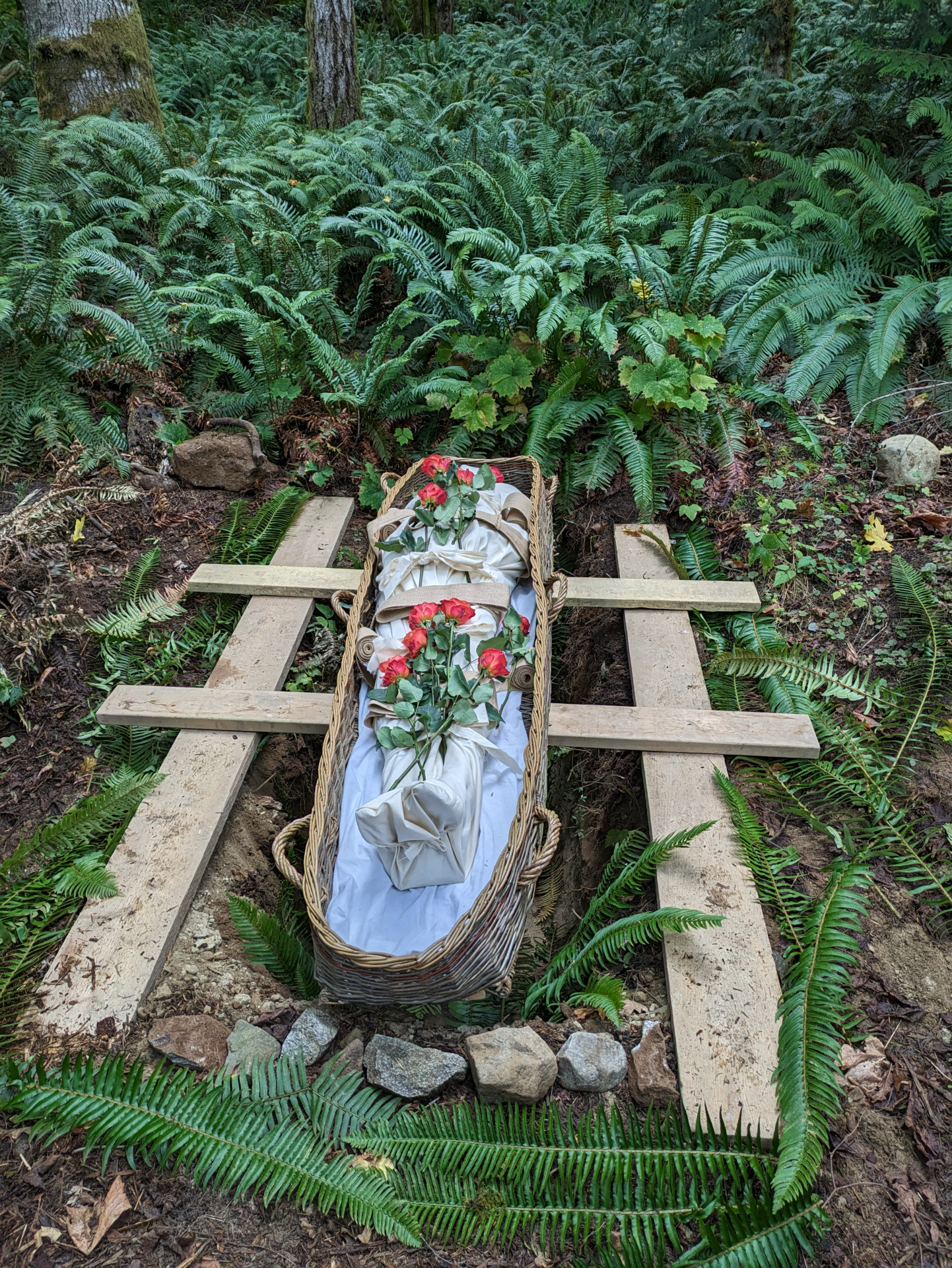
Shrouds – Acceptance, Softness, Truth
by: Virginia Marcolin
Founder of Sanctum and Board Member of the Green Burial Society of Canada
For most of human history, the dead were not dressed in polished hardwood boxes, padded interiors, and layers of metal and lacquer. They were wrapped.
Long before caskets became the norm, across cultures and continents, the shroud was the most universal form of burial. A simple cloth. A final garment. A gesture of care that was intimate, practical, and deeply symbolic.
In ancient civilizations, from Egypt to Greece, from Jewish to Muslim traditions to early Christian Europe, the dead were washed, anointed, and wrapped in linen or wool. The act of shrouding was often performed by family or community members, hands-on and reverent, marking the transition from life to death with ritual rather than technology. Even the Turin Shroud, one of the most famous relics in Christian history, speaks to how central this practice once was: a body wrapped, not boxed.
In many cultures, the shroud represented equality in death. Regardless of wealth or status, everyone returned to the earth in the same way – wrapped simply, without ornament. In Islamic burial practice, this continues today: the kafan is plain white cloth, unadorned, emphasizing humility and the impermanence of the body. In Jewish tradition, the tachrichim are likewise simple linen garments and wrappings, deliberately free of embellishment so that no one is buried “better” than another.
Shrouds also speak to closeness. A wrapped body retains its human shape. There is no rigid container creating distance. The form remains recognizable, almost as if the person is sleeping. For many families, this feels gentler, more personal, and more emotionally accessible than the finality of a sealed coffin.
The environmental dimension is one that modern society is only now rediscovering.
Conventional burial in North America is extraordinarily resource-intensive. Hardwood caskets, steel vaults, concrete liners, chemical embalming fluids, and synthetic fabrics all interrupt the natural process of decomposition and return to soil. A shroud, by contrast, is inherently aligned with the body’s natural cycle. Made of biodegradable fibres – cotton, linen, hemp, silk, wool – it allows oxygen, moisture, and micro-organisms to do what they have always done: transform organic matter back into earth.
For those choosing green burial or natural burial, the shroud is not a niche alternative but the most logical and historically grounded choice. It is minimal, honest, and materially consistent with ecological values. There is no attempt to preserve the body indefinitely, no illusion of permanence – only participation in the same biological process that governs all living things.
Yet the choice of a shroud is rarely only practical. It is emotional, philosophical, and often deeply personal.
Some people are drawn to the simplicity. In a world of excess, the idea of leaving life wrapped in cloth rather than encased in furniture-sized carpentry feels right, even elegant. Others are motivated by spirituality: the symbolism of being swaddled, as one was at birth, and returned to the earth in a similar state at death. The circle closes.
For families, a shroud can also reintroduce tenderness into the funeral process. The act of wrapping a loved one – smoothing fabric, tucking folds, tying gentle bindings – can be
profoundly healing. It restores a sense of agency and participation than modern funeral systems often remove. Instead of standing back while professionals perform every task, loved ones may once again care for the body directly, as humans have done for millennia.
There is also an aesthetic dimension, though it is rarely spoken of openly. Cloth – especially made from natural materials – has always been associated with comfort, warmth, and protection. We dress newborns in soft fabrics. We swaddle. We wrap ourselves in blankets when we are vulnerable. A shroud continues this language of care at life’s end. It is not about decoration; it is about dignity.
Today, as people question the environmental cost, emotional distance, and industrialization of death, shrouds are quietly re-emerging – not as a novelty, but as a return. A return to simplicity. A return to ritual. A return to materials that decompose rather than endure.
Choosing a shroud is, in many ways, choosing a philosophy. It says: I am part of nature, not separate from it. My body is not an object to be sealed and preserved, but a living material that will become soil, roots, and eventually, life again. It says: care matters, even at the end. Touch matters. Cloth matters. Ritual matters.
In a culture that often fears death or hides it behind layers of polish and machinery, the shroud offers something quietly radical: acceptance, softness, and truth.
Frequently Asked Questions
Are shrouds legal in Canada?
Yes. Burial rules are set provincially, and in most jurisdictions a casket is not legally required. What matters is that transportation and burial are handled safely, respectfully, and in accordance with cemetery bylaws.
Do all cemeteries allow shrouds?
Not always. Many conventional cemeteries have bylaws that require vaults or specific containers. Green burial sections and certified green burial cemeteries are more likely to permit shrouds because their policies are designed to support natural return to soil.
If a shroud is used, how is the body lowered safely?
Many cemeteries use a rigid board or biodegradable carrier beneath the shroud to support safe handling and lowering. This keeps the process dignified, practical, and compliant with site requirements.
Are shrouds more environmentally responsible than conventional burial?
Shrouds made from natural fibres (cotton, linen, hemp, wool, silk) minimize material inputs and support natural decomposition. Conventional burial can introduce hardwood, metal, concrete, and embalming chemicals that interrupt soil processes.
Why do standards and certification matter in green burial?
As “green burial” grows in popularity, families can receive inconsistent guidance. Certification helps establish clear, measurable standards so choices are informed, transparent, and aligned with environmental integrity.
Support Transparent Green Burial Standards in Canada
The renewed interest in shrouds reflects a broader return to simplicity, stewardship, and honest care at the end of life.
If you believe in clear standards, credible education, and expanding certified green burial options across Canada,
consider supporting the Green Burial Society of Canada through membership.
